For my final project, I wrote a 7 page paper on the humor as a educational tool in the standard classroom as well as humor's place in music. On Tuesday I posted about 4 videos which I would have shown the class while presenting my project, so please check that out. Here is the link:
https://genderandhumor.blogspot.com/2020/04/major-project-post.html
As a future educator, I am always looking for ways to make students enjoy learning. Now more than ever, students need constant stimulus to stay engaged in the classroom. There are so many things which pull students away from focusing in the classroom, be it the distraction or cell phones or external worries which plague the minds of many. A valuable tool for engaging students is humor. In this class we've explored the other ways humor can be used to address larger issues such as in Hannah Gadsby's Nanette, Ali Wong's Baby Cobra and much more. Humor has the power to stick with us and boost our memory, which is what makes it such a powerful tool in education.
The first link I shared was to a brief interview with the 2018 Louisiana Teacher of the Year, Kimberly Eckert. Eckert explains that teaching is not easy, but the best thing you can do as a teacher is to have fun. Make it enjoyable, and LAUGH! Laughter is notoriously contagious...almost as contagious as a yawn. When teachers and students alike are having a good time in the classroom, students are more likely to attend classes regularly, engage in the class, and perform better in classroom assessments (Appleby). The magic of humor comes from the brain's dopamine reward system. When we laugh, we are creating dopamine in the brain which our brain likes. The brain says, "Oh yes, I like this. MORE! MORE! MORE!" which in turn leads to goal oriented motivation. If the brain associates learning with humor and dopamine, then students are much more likely to engage and come back for more (Henderson).
David Tarvin is a professor at Texas A&M University who vouches for the value of humor in the classroom. In 2018, Tarvin gave a speech for Humor That Works in which he explained how he uses humor to engage students in his college courses. One of the key elements to humor is that it is age appropriate and relevant to what is being taught in the classroom (Powers). Of course, because of the inevitable class clown, humor won't always be relevant but I will touch on that more later. David Tarvin explains that he uses humor in one of three ways: association, applied improv, or personal stories. In the case of association, what makes it work is by teaching about one thing through another which students may be more familiar with. The example Tarvin uses is that he teaches about Sophist rhetoric, Tarvin associates Gorgias' defense of Helen and Palemides with a defense of Scar from The Lion King. While neither Sophists or The Lion King are inherently funny, what makes this humorous is imagine: you walk into your college classroom knowing that according to the syllabus you're going to have to listen to your professor drone on about Sophist rhetoric and the tale of Gorgias for like 50 minutes, and all of a sudden, your professor just starts talking about Scar from The Lion King out of the blue, defending him and why he maybe wasn't all that bad. Imagine the confusion in the classroom, yet the enjoyment of debating something familiar that all of the students in the classroom are familiar with. At the end of class, the professor removes the cloak from the purpose of the discussion and relates your entire debate back to Sophist rhetoric and the story of Gorgias and his defense of Helen and Palemides. All of a sudden it makes sense but you enjoyed learning about something old through something new.
This technique can be used when managing the class clown. Maybe your class clown is constantly chiming in with unnecessary comments about something completely unrelated, or maybe a prank was played. In that moment, the teacher has two options: discipline the inappropriate behavior and create tension in the classroom, or find a way to roll with it and create a lighthearted and humorous energy in the classroom. While both are going to be a disruption to the normal flow of the class, finding a way to roll with the distraction offers a way for the teacher to engage the students and get them back on track without majorly disrupting the energy of the class.
So what about the music class? Well, in many ways the music classroom isn't actually all that different that standard classroom. Students are still students; they still goof off and they still respond to humor. As with humor in the normal classroom, humor in the music classroom should be relevant. Music isn't inherently funny, but there is a history between music and satire which I will touch on later. Humor in the music class can be more than just jokes about instrument stereotypes.
"How many trumpet players does it take to change a light bulb? 5. One to change the light bulb and 4 to tell them how much better they could have done it."
Instrument jokes aside, parodies are a great way to integrate music into the standard classroom as well as the music classroom. Parodies in the music classroom hold a special opportunity that parodies out side of the music classroom don't have: music-related parodies can teach about the music to the song they are sung to. My favorite example of this is The Music Theory Song by David Swenson, which I liked in my previous post. While most of it probably won't make sense to you if you aren't familiar with music theory, this song explains the music theory of the song to the tune of the original melody. This technique is actually used rather often especially when familiarizing students with intervals. I remember when I took music theory in high school that I learned intervals through songs. The wedding song that goes "here comes the bride" is a perfect fourth, the beginning of the Star Wars opening theme is a perfect fifth... I digress.
As I mentioned before music and satire have a history. John Gay, the composer of The Beggar's Opera wrote the opera in the 18th century and the sole purpose of the opera was to make fun of Italian opera. People loved The Beggar's Opera so much that they stopped going to see Italian operas and these composers started to really financially struggle. The Beggar's Opera makes fun of the Prime Minister of Great Britain at the time. The opera makes fun of the socio-economic inequity of the upper class aristocrats and the lower class thieves and whores. Music may have a reputation for being elitist and serious, but there is humor in music.
Using humor in the music class and standard classroom alike should always be relevant and appropriate. The song I linked from The Beggar's Opera in my previous post is "Our Polly is a Sad Slut" which would MOST CERTAINLY not be appropriate to share with elementary or middle school students. The same goes for the relevancy of jokes. If I am teaching about math, I probably shouldn't just break out jokes about instrument stereotypes, but jokes about math? Those would certainly be more relevant. What it all truly comes down to is whether or not using humor would improve the class or take away from it, as with any joke and with any educational methods. If you aren't a naturally funny person and trying to be funny is like pulling teeth, don't try to be funny in the classroom because it just wouldn't help you or the students. If you have a sick, dark, twisted sense of humor, maybe telling those dark jokes and being twisted towards your students isn't the place for that. If you just happen to have one of those senses of humor where you can turn everything into a joke, don't hold back! Just make sure it is appropriate and relevant. Maybe it even is used as a Segway between two topics. Who knows. Humor is powerful and can turn a whole day around. It even boosts memory and retention! It is a very valuable tool to use in the modern classroom because it engages students and improves the mood of the classroom.
Friday, April 24, 2020

Religion and Comedy: A Focus on Islam
Intro/Thesis:
** Here's some context: I always wanted to somehow tie together comedy and religion since both mean a lot to me. With this project, I decided that I wanted to show how comedy can be used to unite people of a specific faith, and in this case I decided to focus on Islam. On the other hand, religious comedy has the opportunity to either deconstruct or reinforce stereotypes surrounding a religion, which I also wanted to highlight. That is the essence of my project! Anyways, here's my intro:
Comedy has always been an easy method of relating and uniting groups of people. Through laughter, comedians can bond groups of people together with shared struggles or situations, like jokes about traffic or specific political groups or evil bosses. On the other hand, there are subjects less joked about in an effort to remain unoffensive. For instance, the Holocaust and 9/11 are subjects deemed unapproachable in comedy. In this same way, religion has often times been seen as off-limits. Making jokes about a particular religion can sometimes be viewed as offensive in one sense or unrelatable to those outside of the religion. However, there is a growing consensus that religion and comedy actually go hand-in-hand, and this shifting of opinions is best seen through Muslim comedians. Comedians like Hassan Minhaj, Mo Amer, and Ramy Youssef demonstrate that combining religion with comedy effectively unites believers of that faith, yet consequently their humor has the power to reinforce or deconstruct stereotypes surrounding their beliefs.
Tell us about what you did: Talk about your process and/or structure. How did you support your thesis and arrive at your conclusion?
So the first thing I did for my project was create an outline. Here is the original outline:
“So what?”: Why is your project important? Answer the “so what?” question.
This project is important because we never really talked about religious comedy in class. Through this project, I wanted to show how these religion and comedy wonderfully go hand-in-hand. Furthermore, I wanted to show the perspective of Muslims in comedy because this religious group is facing so much unwarranted heat in America today. These comedians talk about all of the prejudice and hate they have received, especially in the years after 9/11, that you laugh and at the same time your heart breaks for them. Still, because of their experiences, they can spread laughter and understanding and hope to their fellow believers that have also faced the same injustice. In the end, I wanted to share the unique perspectives of religious comedians in America today through the eyes of these phenomenal Muslim Americans.
What did you learn? What surprised you?
I was so surprised to hear how these Muslims experienced so much intense hate after 9/11. For example, Hasan Minhaj talked about how, immediately after 9/11, someone called his family and said, "Hey, *insert slur here*, where's Osama Bin Laden?" They continued calling his family slurs before hanging up, and then soon after his family's car windows got smashed in! This is just one small example of the constant fear and hate that these Muslims have to endure as revealed by these Muslim comedians. Even though these three comedians have lived as Americans all their lives, they have still experienced so much prejudice from their country - it's absolutely astounding how much they've been forced to endure.
** Here's some context: I always wanted to somehow tie together comedy and religion since both mean a lot to me. With this project, I decided that I wanted to show how comedy can be used to unite people of a specific faith, and in this case I decided to focus on Islam. On the other hand, religious comedy has the opportunity to either deconstruct or reinforce stereotypes surrounding a religion, which I also wanted to highlight. That is the essence of my project! Anyways, here's my intro:
Comedy has always been an easy method of relating and uniting groups of people. Through laughter, comedians can bond groups of people together with shared struggles or situations, like jokes about traffic or specific political groups or evil bosses. On the other hand, there are subjects less joked about in an effort to remain unoffensive. For instance, the Holocaust and 9/11 are subjects deemed unapproachable in comedy. In this same way, religion has often times been seen as off-limits. Making jokes about a particular religion can sometimes be viewed as offensive in one sense or unrelatable to those outside of the religion. However, there is a growing consensus that religion and comedy actually go hand-in-hand, and this shifting of opinions is best seen through Muslim comedians. Comedians like Hassan Minhaj, Mo Amer, and Ramy Youssef demonstrate that combining religion with comedy effectively unites believers of that faith, yet consequently their humor has the power to reinforce or deconstruct stereotypes surrounding their beliefs.
Tell us about what you did: Talk about your process and/or structure. How did you support your thesis and arrive at your conclusion?
So the first thing I did for my project was create an outline. Here is the original outline:
- Introduction
- Religion and comedy in general (point out my articles)
- Religion and comedy in general (look at Jenny Slate??)
- Religion and comedy reinforcing stereotypes (look at article with Jewish comedians and another article?)
- Islam and comedy (talk about terrorists and extremists?)
- Islam and comedy (Muslim comedians’ responses to that?)
- Hassan Minhaj (interviews or clips I find)
- Hassan Minhaj (how his special unites Muslim audience members)
- Hassan Minhaj (how his special deconstructs stereotypes?)
- Mo Amer (interviews or clips I find)
- Mo Amer (how his special unites Muslim audience members)
- Mo Amer (how his special potentially reinforces stereotypes)
- Ramy (interviews or clips I find)
- Ramy (how his special unites Muslim audience members)
- Ramy (how his special deconstructs stereotypes)
- Ramy (episode one – how it unites)
- Ramy (episode one – how it DECONSTRUCTS stereotypes)
- Ramy (episode two – how it unites)
- Ramy (episode two – how it DECONSTRUCTS stereotypes)
- Conclusion
“So what?”: Why is your project important? Answer the “so what?” question.
This project is important because we never really talked about religious comedy in class. Through this project, I wanted to show how these religion and comedy wonderfully go hand-in-hand. Furthermore, I wanted to show the perspective of Muslims in comedy because this religious group is facing so much unwarranted heat in America today. These comedians talk about all of the prejudice and hate they have received, especially in the years after 9/11, that you laugh and at the same time your heart breaks for them. Still, because of their experiences, they can spread laughter and understanding and hope to their fellow believers that have also faced the same injustice. In the end, I wanted to share the unique perspectives of religious comedians in America today through the eyes of these phenomenal Muslim Americans.
What did you learn? What surprised you?
I was so surprised to hear how these Muslims experienced so much intense hate after 9/11. For example, Hasan Minhaj talked about how, immediately after 9/11, someone called his family and said, "Hey, *insert slur here*, where's Osama Bin Laden?" They continued calling his family slurs before hanging up, and then soon after his family's car windows got smashed in! This is just one small example of the constant fear and hate that these Muslims have to endure as revealed by these Muslim comedians. Even though these three comedians have lived as Americans all their lives, they have still experienced so much prejudice from their country - it's absolutely astounding how much they've been forced to endure.
What is your favorite part and why?
My favorite part was, first of all, watching all these comedy specials/episodes! I had a ton of fun and a ton of laughs, and it was great entertainment during this quarantine. Of course, my top favorite part was learning about these perspectives. Personally, I'm an incredibly empathetic person, so learning about these harsh, crazy experiences made me feel for these comedians and the Muslims in America. I feel like a better, more educated person after all of this, and I almost wish my arms were big enough to hug all of the Muslim Americans out there at once?? Anyways, writing the project was definitely stressful, but doing the research and learning a little more about the lives of Muslim Americans made it (mostly) worth it.
Thursday, April 23, 2020
Art and Beauty Standards: Perfection is Impossible
My project topic was to
look at unrealistic beauty standards for women in society through the pieces we
read in class, studies conducted on this topic, finding images online and then use
myself as a canvas to portray a direct defiance of these standards through my appearance.
For my major project, I created a slideshow of images and my own personal
photos of defiance of how beauty standards are used against women in society. I
also wrote a 6-page paper looking at how the pieces we read in class, the studies
I found on this topic, and my personal analysis as well to help support my
thesis. My thesis was: “The literature of these amazing authors and this class
has inspired me to create a statement in the form of artwork, both through
images from media and using myself as the canvas.”

I used this project as an
opportunity to be able to talk about a topic that I am passionate about and be
able to make a well-informed and powerful argument for this issue. I first
researched studies that looked at how unrealistic beauty standards effected
women in their daily lives for work, and also in their personal lives regarding
their own self-image. I then looked for images to help portray these
unrealistic beauty standards in a very visual way and composed them into a
slideshow. After that, I looked at the writings of Fanny Fern and Amy Poehler where
they discussed a woman’s image in society, how they are judged, and then how
they were directly affected by it. Then, I also included parts of Tig Notaro’s
comedy special “Happy to be here” by referencing her appearance while she
performed and when she talked about how she is judged on a daily basis for her
appearance and how she is mistaken for a man at least once a day.

I compiled all of this
into both my paper and slideshow and was so happy with how it turned out. I was
able to support my thesis by using the studies I found as evidence to support
my claim, by incorporating the readings we had from Fern and Poehler and the comedy
show by Notaro to present some real-life examples of how these unrealistic
beauty standards affect women in their lives, and then I finally used the
images I found on google by using the simple search key of “perfect woman.” The
project as a whole showed me just how bad this issue actually is, and I have only
scratched the surface of it. However, I felt a sense of pride and gratification
after being able to share my piece and use my form of self-expression through
my appearance to show defiance to the beauty standards and the love I have for
myself no matter how I look.

This project was not only
important to me personally, but important in general for the following reasons.
It showed the double-standards women face and the oppression of women in
society by judging them on their appearance and the idea that they can be this “perfect
woman” in appearance. This project was just another voice that was added to the
roar of women who are demanding to be respected and not be judged by their appearance
in their daily lives. Especially since our male counterparts are not able to
enjoy the same treatment that us as women have to endure. The only way change
will happen is we join together and demand that it happens, and this project
only adds to the increasing scream and shout of the movement that is demanding
just that from the society we live in. I refuse to let my voice be silenced by
the society I live in, and this project was my way of joining that roar.

Now I already knew a lot
about this subject matter since I am a proud feminist and refuse to be caught
uneducated about topics like these that affect me on a daily basis and still
have to educate others about. (Insert forehead slap here) However, I still
managed to learn some new things to add to my ever-growing knowledge on these
subjects. I leaned that this brainwashing of unrealistic beauty standards is affecting
girls as young as fourth grade, and probably even younger, during a time when
KIDS are supposed to be enjoying their childhood, not worrying if they are “perfect”
in their appearance. This was surprising as well since it confirmed for me that
young girls are starting to worry about this at such a young age when they
should be having fun, feeling carefree, and living life to the fullest. This
showed that society is robbing children of their childhood’s, and it makes me
sick to my stomach knowing that its not going away anytime soon.

My favorite part about this whole
project was being able to talk about an issue that is close to my heart and
that I am incredibly passionate about (if you couldn’t tell by now XD). The whole
process of finding evidence to support my claim and putting it all together was
so incredibly cathartic, and I am so proud of the finished product I created.
This project allowed me to speak out and share my voice in an environment where
I felt safe enough to not feel judged for it. I hope if you made it this far
that you enjoyed this post as much as I did, and that you have fabulous rest of
the semester. Keep being fabulous <3
The Words That Hurt Us
For my project, I decided
to make 10 digital portraits of female comedians and classmates, paired with oppressive
insults they have received personally. This idea is centered in the concept of
linguistic reclamation, or taking back hateful words as an act of defiance and
self-love. The portraits I have created for this project are meant to be that
act, solidified.
(I am including all 10 portraits below, hopefully this doesn't ruin the quality of them, but if it does and you would like to be sent a better quality version, just let me know!)

Elana

Kelsey

Aneyla

Daisy

Hannah Gadsby

Holly

Kennedy

Phoebe Robinson

Tina Fey
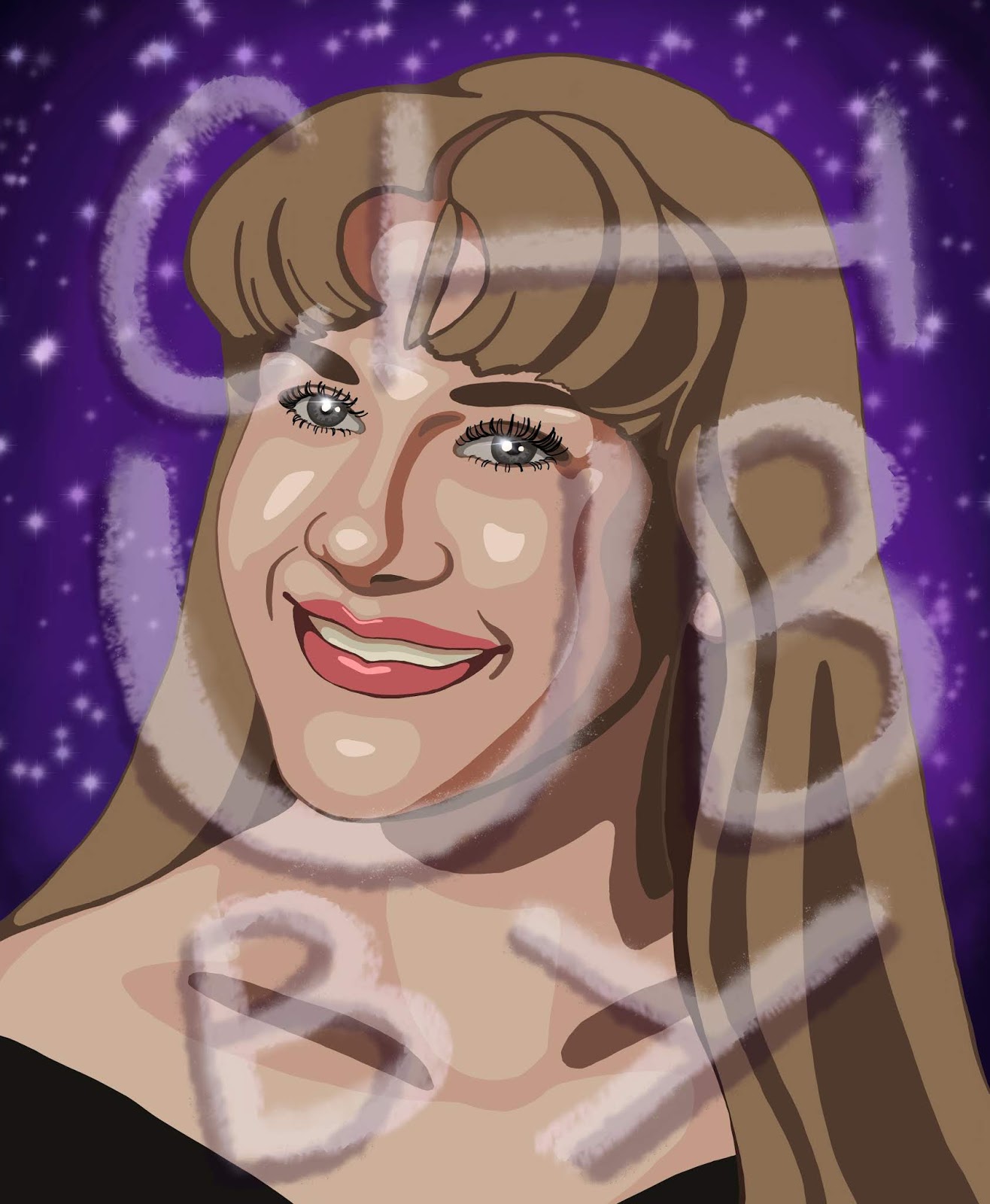
Vivienne
The portraits were
completed before the writing portion of my project, partially because my
mini-essay dealt mostly with the visual details of the portraits. Starting out,
I first collected pictures of the volunteers from our class and of the famous
comedians, some of which I had chosen because of specific quotes using oppressive
language from their blog posts. The only stipulations for the pictures of our
classmates were that it had to be a picture of themselves that they liked a
lot, for one reason or another. By doing this, I have support for my argument
of pairing an oppressive insult with a portrait that represents confidence and
self-assurance. After making the digital portraits, I began on the writing and
research portion of my project, where I found a few interesting sources about
the history and/or present day usage of linguistic reclamation. For example, we
have been using the word “queer” in this course to refer to members of the
LGBT+ community in a generalized yet respectful manner, there has even been a
blog discussion on non-LGBT+ people using this word specifically, but for a
very long time, this word was used to oppress gay people. This is my overall
goal with this project, to take the words used by others to oppress women and
turn them around, pair them with a confident face, and let the world know that
those words no longer have the power over women that they once did.
I believe this is
important for many reasons, but to say it in the broadest sense, I believe this
project is important for the same reasons that refraining from self-deprecating
humor is important. The tools that our historically patriarchal society has
used to oppress women and gay people have become normalized, even traditional.
By doing the things that Hannah Gadsby talks about in Nanette, by not
giving in to the internalized-misogyny/homophobia-is-funny ideology, we are
able to gain back the power that has been withheld from us.
I learned a few things
throughout the span of creating this project. First of all, I should admit, I
initially wanted to do this project because I had just gotten an iPad and Apple
Pencil to make digital art and I wanted to see what I could do. I am thankful I
did, though, because I learned a lot about creating digital art in the process,
and I was able to personalize each of the portraits so that the words could
have certain effects that would emphasize their oppression and negativity. I
also learned a lot about my classmates, which was really wonderful and made my performance
on the project even more important to me. I don’t think I was surprised by much
aside from my classmates’ willingness to participate in the project, as well as
their positive reactions when I showed them their portraits in the draft stages.
I would have to say that
my favorite part of this project was the actual creation of the art, and how
involved my classmates were in that process. Dr. Hanrahan was always very
supportive as well, when I met with her to show her my progress, and this involvement
by both Dr. Hanrahan and my classmates motivated me to make these portraits as
perfect as I could. I am happy to be able to create several artworks that you
all can understand, and hopefully appreciate, alongside me!
Recipe for Comedic Success (and its many added notes)
For my multimodal project, I created a “Recipe for Comedic Success”, which you can see at the bottom of this reflection. My “Recipe for Comedic Success” reflects a reality in the comedy world: what can work for straight white men is not the same as what works for women and other marginalized groups.
I did some background research on the differences between sets done by male and female comedians, as well as who is most ridiculed by male comedians. I read the works by Ali Wong, Fanny Fern, and Phoebe Robinson in order to come up with examples for three main parts to my conclusion.
First, marginalized groups have to be able to tell jokes about the opposite gender differently. In Ali Wong’s book Dear Girls, when she talks about giving birth to her oldest daughter, Mari, all her husband can say to her when she says anything is, “Okay.” It’s a twist on the “she’s just complaining” trope; instead of her complaining about something and him just agreeing to stay out of trouble, he wants her to be happy because it makes him happy. Fanny Fern made her own husband seem disconnected and almost absent from their family. She wanted to make the point that while women are often criticized for “not doing enough”, the husbands are the ones that needed to put in more effort.
Second, marginalized groups have to be aware of preconceived notions the audience already has about them. Phoebe Robinson struggled with staying true to herself while performing in front of a judging panel. They wanted to piss her off for better ratings. She not only had to maneuver through questions about her appearance, but she had to keep calm in order to avoid making a scene, which would have “proven them right”.
Third, physical appearance matters. Robinson’s performance would be an easy example here, but so would Wong’s Netflix specials. When she performed in both of her comedy specials, she wore a tight dress to show off her stomach. Normally, women in comedy shy away from showing off their bodies in ways that they think are “unflattering” because they want the audience to take them seriously. However, Wong makes the implicit point that if people are going to stare at her, she might as well give them something to look at.
So why is any of this important? Being a part of the dominant group in comedy allows for more freedom in expression, especially in jokes and appearances. When a comedian comes from a marginalized background, the topics and expressions are more limited, but in recent times, these same comedians are defying what is expected of them in order to succeed. This is incredibly important when it comes to diversifying comedy and making the audience feel more accepted. The recipe is supposed to show the expectations of the industry, versus what we as a class already know to be true.
I learned that while being funny in comedy is important, without a purpose, a comedian from a marginalized group isn’t going to get very far. Comparing this to a straight, white man, who only needs to look like he’s alive in order to get on stage (that’s an exaggeration—even they have to go through a lot of trial and error, but in comparison to the journey of a black woman in comedy, it seems a heck of a lot easier. My apologies if this was offensive), it seems that most successful comedians from outside the dominant group have to be driven by something, whether it is a cause or someone in their life.
I was surprised by how hard it was to actually write down some of the notes on the recipe. After taking this class, I didn’t want to even think about what other people in comedy might say to marginalized groups about how to perform. The more I wrote, the angrier I got, which I guess was the point.
My favorite part of this project was the research. As someone who despises research, the sources I read were actually really interesting.


Works Cited
Balirano, Gisueppe, and Delia C. Chiaro. “Queering Laughter? It Was Just a Joke!” De Genere: Journal of Literary, Postcolonial and Gender Studies, no. 2, 2016, pp. 1–9., www.degenere-journal.it/?journal=degenere&page=article&op=view&path%5B%5D=45.
Boym, Nina. “Aunt Hetty on Matrimony.” The Norton Anthology of American Culture, by Fanny Fern, 1820th-1865th ed., B, W.W. Norton, 2012, pp. 907–908.
Robinson, Phoebe. You Can't Touch My Hair: and Other Things I Still Have to Explain. Plume Book, 2016.
Wong, Ali. DEAR GIRLS: Intimate Tales, Untold Secrets and Advice for Living Your Best Life. Random House, New York, 2019.
Wednesday, April 22, 2020
LGBTQ+ Women in Comedy: Is it a good place?
Comedy as A Safe Space for LGBTQ+ Women
For my project I wrote a paper examining whether or not comedy is used as a
safe place for women who are part of the LGBTQ+ community. I referred back to
authors we’ve discussed during class, and even included a few female comedians
we hadn’t discussed that I absolutely adore.
My argument included the question(s), if and why women in the LGBTQ+ community
used comedic expression, and if not, why? After conducting research and finding
many, many sources, I found that my thesis statement had been supported. Out of
the three female comedians I chose to include in my project, it was found that
all three used humility as a form of expression, but in different ways. For
example, Hannah Gadsby believed comedy wasn’t a safe place for her to express
herself because of her own experience being revolved vastly around
self-deprecation. Ellen DeGeneres and Lea DeLaria both projected themselves as
being fond of using humor as a safe space. DeGeneres did similarly use
self-deprecation but approached it differently with affiliative humor, her
reactions to situations of adversity were much different. For example she spoke
on the topic of her coming-out and when doing this she implemented a scenario
that everyone would enjoy/relate too, then finished the conversation expressing
the seriousness in what occurred to her, and others who may have experienced
similar things. DeLaria approached her comedy in a more relaxed,
confrontational tone and used and she is more comfortable with her comedy. She
uses a more self-enhancing approach to her comedy and refuses to let anyone
make her feel the adversity that's placed on her as a butch woman.

This project is important because we often don’t think about the thing’s
comedians endure to create messages for their audiences. These things include
incidents such as trauma, adversity, rejection, etc. The messages these LGBTQ+
women give are all similar, but different because it shows us everyone has a
story of their own and to cope with what occurs, they resort to various forms
of expression and for some, it may not always work.
My most favorite part about doing this project was researching and watching
videos and specials on these wonderful women, learning more about their stories
and how they express themselves. Humility is something we all partake in
everyday and it could be to cope with stress, make others laugh to make their
day better, etc. and I thought doing this research was pretty fun to do. Humor
may not always be a good place for everyone to reside to share their stories,
but there is always a powerful message that comes across the stories being
told. Using these three women in my project I thought really shined a
light on comedy and how people from different backgrounds, or even those who
identify under the same groups and communities share their stories differently in
comedy. All of these women have powerful voices they continue sharing, and I
believe that is absolutely beautiful in its own way. Having powerful voices
like theirs encourage others, including myself to share the stories we live through
different forms of expression whether it be comedy, writing, contemporary art,
etc.
Beyond Me Too
Hey friends!
Earlier this semester, I attended a “Women in Academia” panel where Dr. Slocum-Schaffer mentioned something called amplification, a tactic women in the Obama administration started which involved highlighting and restating their female peers
ideas until they were recognized by the larger group. I’ve been fascinated by the idea ever since because it’s so easily applicable to every aspect of our lives. I also knew I wanted to connect my project to the Me Too movement somehow, so I decided to combine
these two ideas together. The final product ended up being a sort of visual blog.
I asked for volunteers who were willing to share their story, whatever that meant to them, and I pulled powerful quotes from their audio recordings to turn into more artistic pieces that I posted on an Instagram account I made
specifically for this project, @beyond.me.too. I decided to title it “beyond” because I believe Me Too and other similar movements have shown that the world listens less to the voice of a woman, no matter the topic. While stories of sexual violence are especially
stigmatized and sensitive, I wanted anyone involved with this project to be able to share any story that has deeply affected them as a woman, whether it’s related to sexual violence or something completely different. I was originally planning to post only
the artistic quotes on the Instagram page (my inspiration for this comes from @sophia.joan.short), but I quickly realized the words these women were speaking were too heavy and impactful for me to simply choose a few quotes and hope they were accurately representing
the story as a whole. I decided to post the written dialogues alongside the artistic quote pieces so others could see the whole story as I did.
This process was more difficult than I originally thought, so going forward, I’m going to link a blog account to the Instagram. This way, I’ll be able to post the artistic quotes as a sort of intro or cover art, and then link it to the actual
story which will be on the blog. This will make things easier for me to upload, and the formatting will be more clean and precise. I’ll also have the option to upload pieces from the original audio clips with the participants permission, which I’m excited
about because I quickly realized in the middle of this project that no series of words I string together will ever match the power of a human voice. I couldn’t replicate their sobs, their long pauses, the moments their voices cracked. As I continue this project
(as I plan to), I hope to find a way to better incorporate a real sense of voice in the pieces.
The best part of all the work that I did was the bonds I was able to form with the participants. Listening to both the pain and the bravery in their voices inspired me to share my own story, which I wasn’t originally planning to do. The way
we were able to connect on such a deep level is something I would have never experienced without this project, and I’m grateful.
I chose this project because I wanted women to feel heard, to actually be heard. Since the account is public, I’ve already gotten messages from several friends telling me that the account has impacted them in some way, and asking to share
their own story. I’m so proud and so hopeful, because I know that when it comes time to take a new, bigger step, I have several women behind me who are ready to run.
Here's the account: Beyond Me Too
P.S. Yes, the Nick you'll read about in my story is our Nick. I have first-hand knowledge that he is the best person you’ll ever meet.
Subscribe to:
Posts (Atom)